


Intro
AI Doomerism is distinct from general tech pessimism about issues like job losses or economic disruption. It describes people who believe that advanced AI poses a risk of human extinction. Much of this apocalyptic worldview took shape within overlapping rationalist and effective altruist circles.
How did this worldview, once largely confined to internet forums, become an organized political movement with media and political access?
To understand its rise, follow the money.
Executive Summary
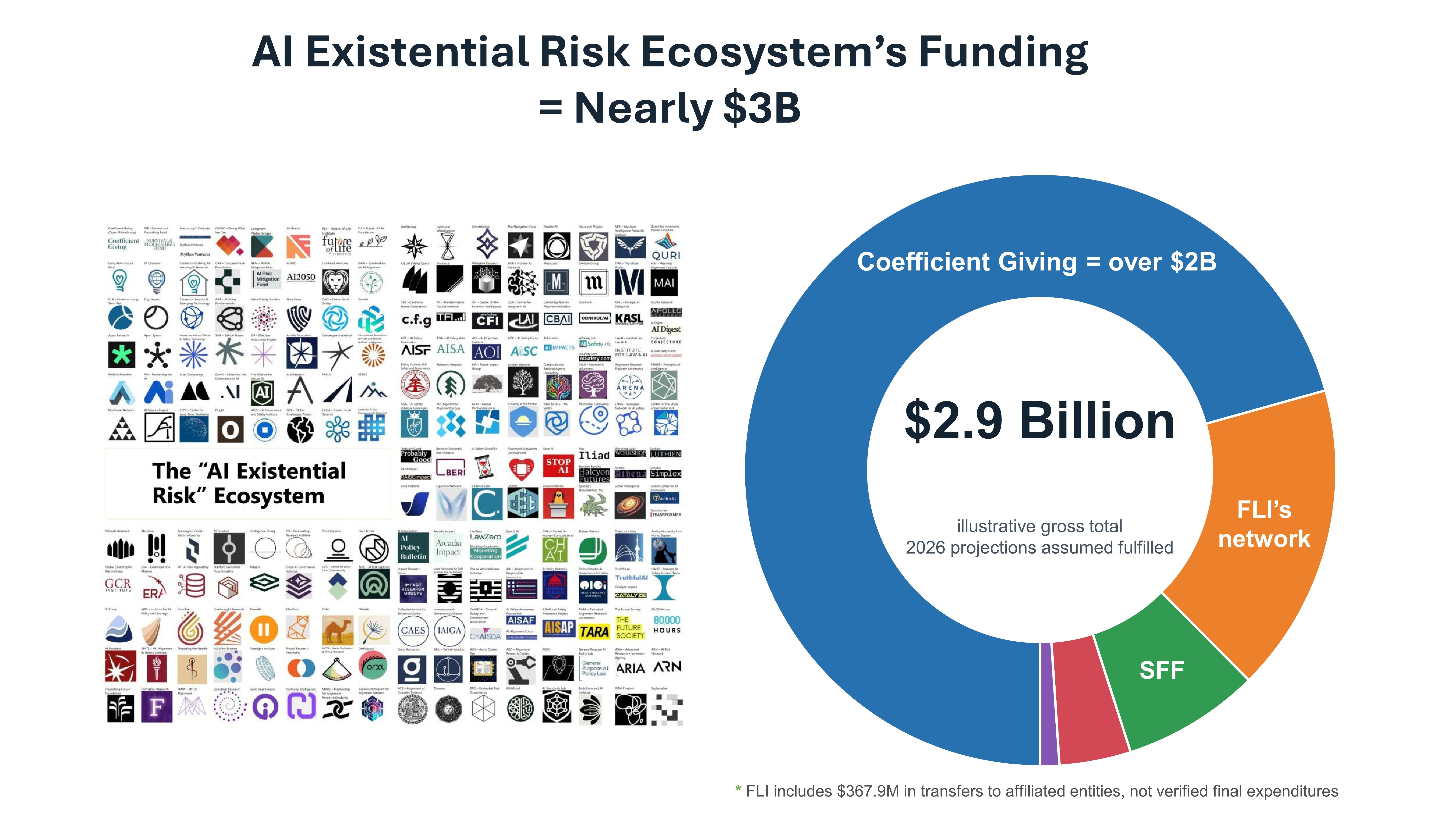
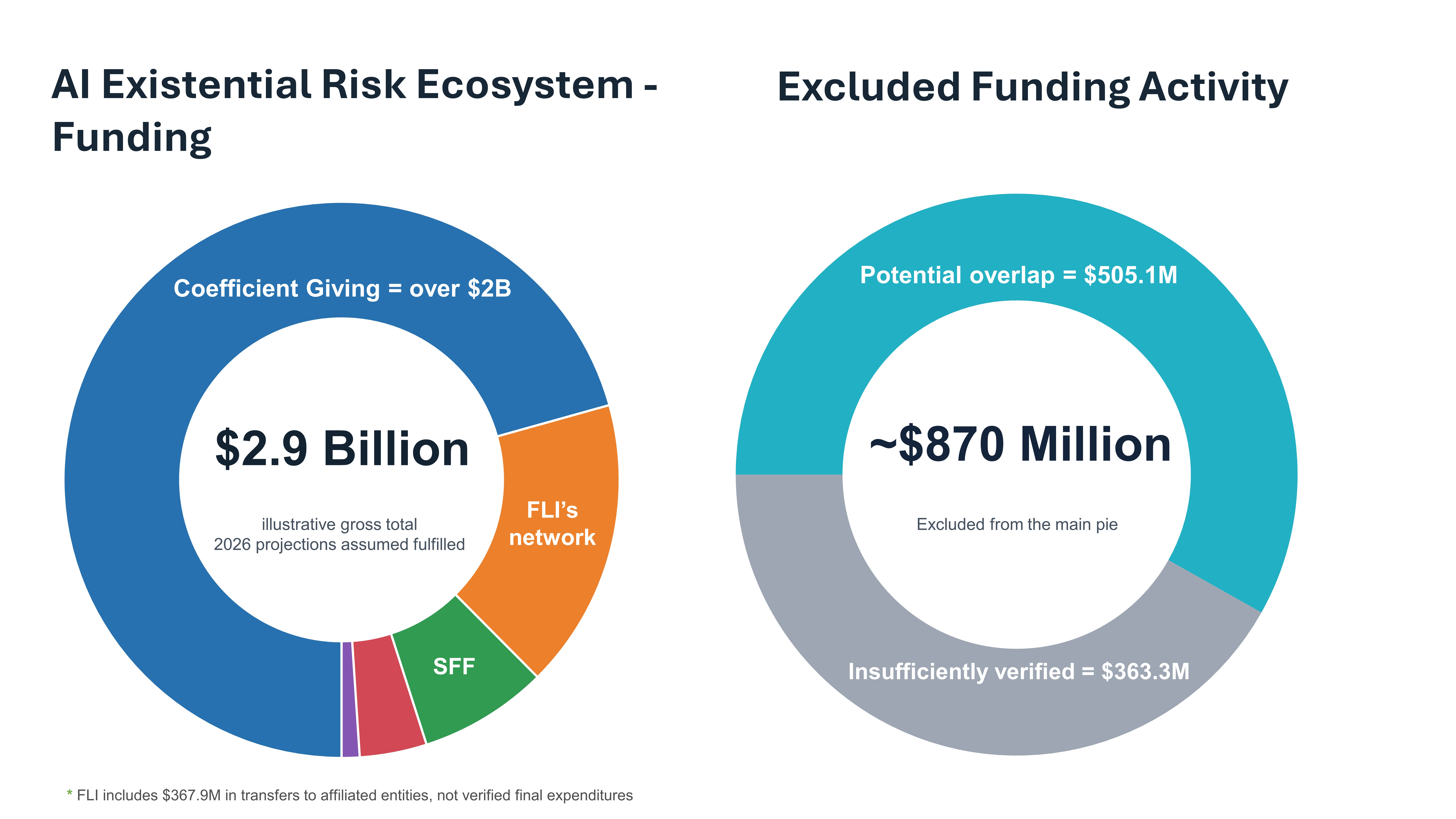
This investigation maps nearly $3 billion in funding associated with the AI existential risk ecosystem.
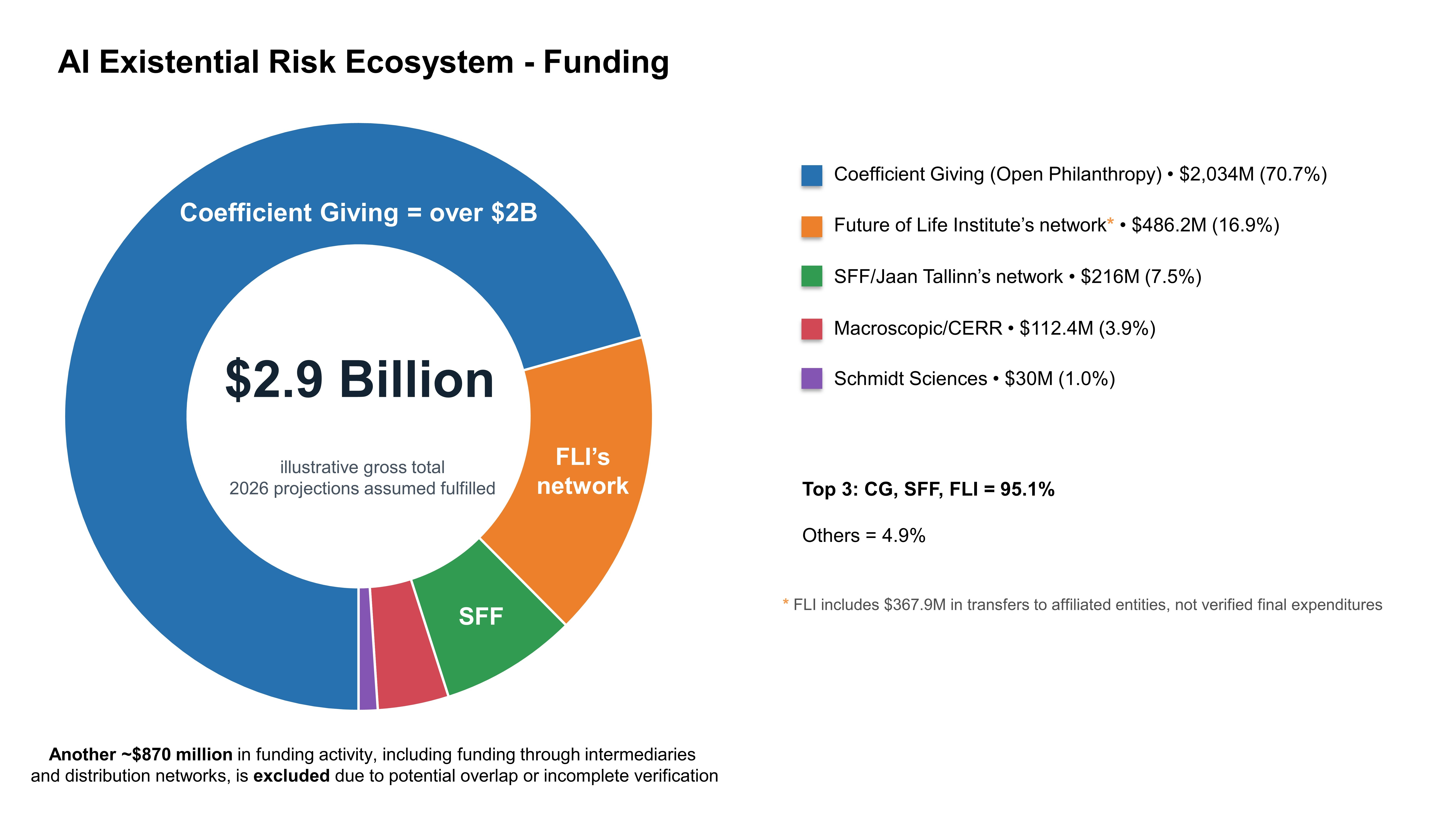
The illustrative total of $2.9 billion ($2.879B)[1] combines historical philanthropic funding, capital transfers, and projected 2026 commitments.
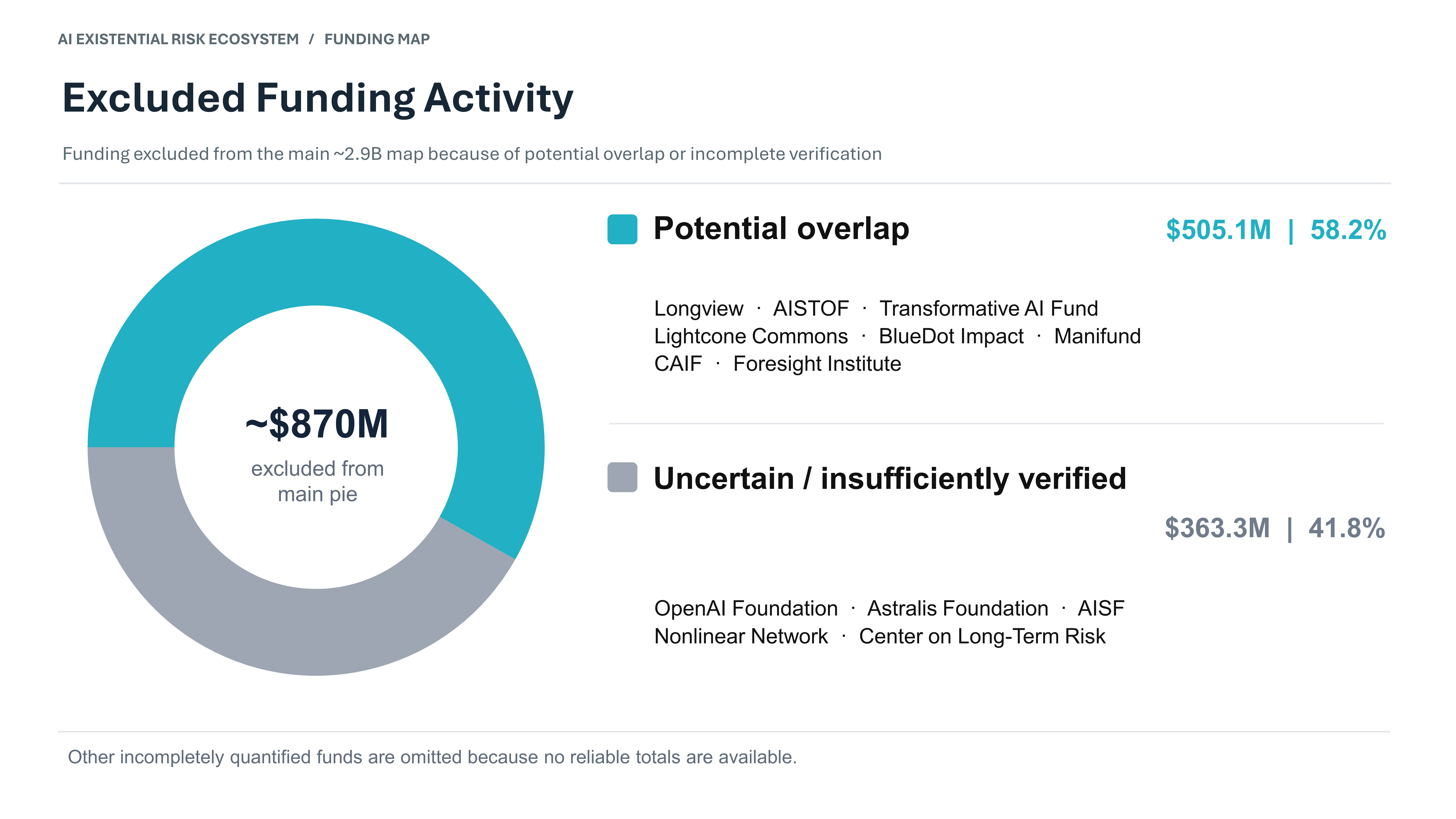
The calculation deliberately excluded another ~$870 million ($868.4M) in reported, estimated, or projected funding activity because of potential overlaps, uncertain sources, or incomplete verification.
The largest funding source is Coefficient Giving (formerly Open Philanthropy), which accounts for approximately 71% of the mapped total.
The Funding Surge
Two billionaire philanthropists, Facebook co-founder Dustin Moskovitz and Skype’s founding engineer Jaan Tallinn, have played central roles in building and expanding the AI safety and alignment ecosystem, alongside other major donors, including Ethereum co-founder Vitalik Buterin and Sam Bankman-Fried, former FTX chief and a convicted felon. Bloomberg described the movement’s funding environment as “a culture of free-flowing funding with minimal accountability.”
Earlier estimates placed funding for the effective altruism movement’s AI existential-risk network at about $1 billion to $1.6 billion, supporting hundreds of organizations devoted to AI risks.
Those estimates are now outdated.
In September 2026, Coefficient Giving, the biggest effective altruism funding arm, reported that it committed $351 million in 2025 to AI safety and was on track to commit more than $1 billion in 2026 alone.
Combining its historical AI-related grantmaking with this projected 2026 commitments brings its illustrative total to more than $2 billion.
Practical ramifications: From funding to influence
The financial backing has helped establish an extensive institutional infrastructure: research institutes, fellowships, training pipelines, media initiatives, and advocacy groups. It gave this particular risk frame unusual agenda-setting capacity.
Policymaking: Hundreds of millions of dollars have supported policy advocacy organizations and regulatory initiatives. Under “AI governance,” there is a spectrum of assumptions, objectives, and proposed solutions. While some efforts focus on standards and evaluations, others advocate extreme restrictions on AI development. Certain proposals go as far as recommending surveillance of AI researchers, their locations, computers, and research activities.
Media and public narratives: Tens of millions of dollars have flowed into journalism, media initiatives, and communications campaigns. Major organizations are also paying and promoting content creators to push AI existential risk messages to the public through “sponsoring social media posts and partnering with influencers.” AI-doom-focused YouTube channels have collectively accumulated hundreds of millions of views.
The AI existential risk ideology did not become a political movement on its own. Billions of dollars in funding can shape which arguments receive institutional support, which research agendas expand, which careers become viable, which narratives attract media attention, and which policy proposals reach lawmakers.
The danger is that a relatively small but well-funded network is seeking oversized moral and political authority over everyone else’s AI future.
1. Mapped Funding by Major Network
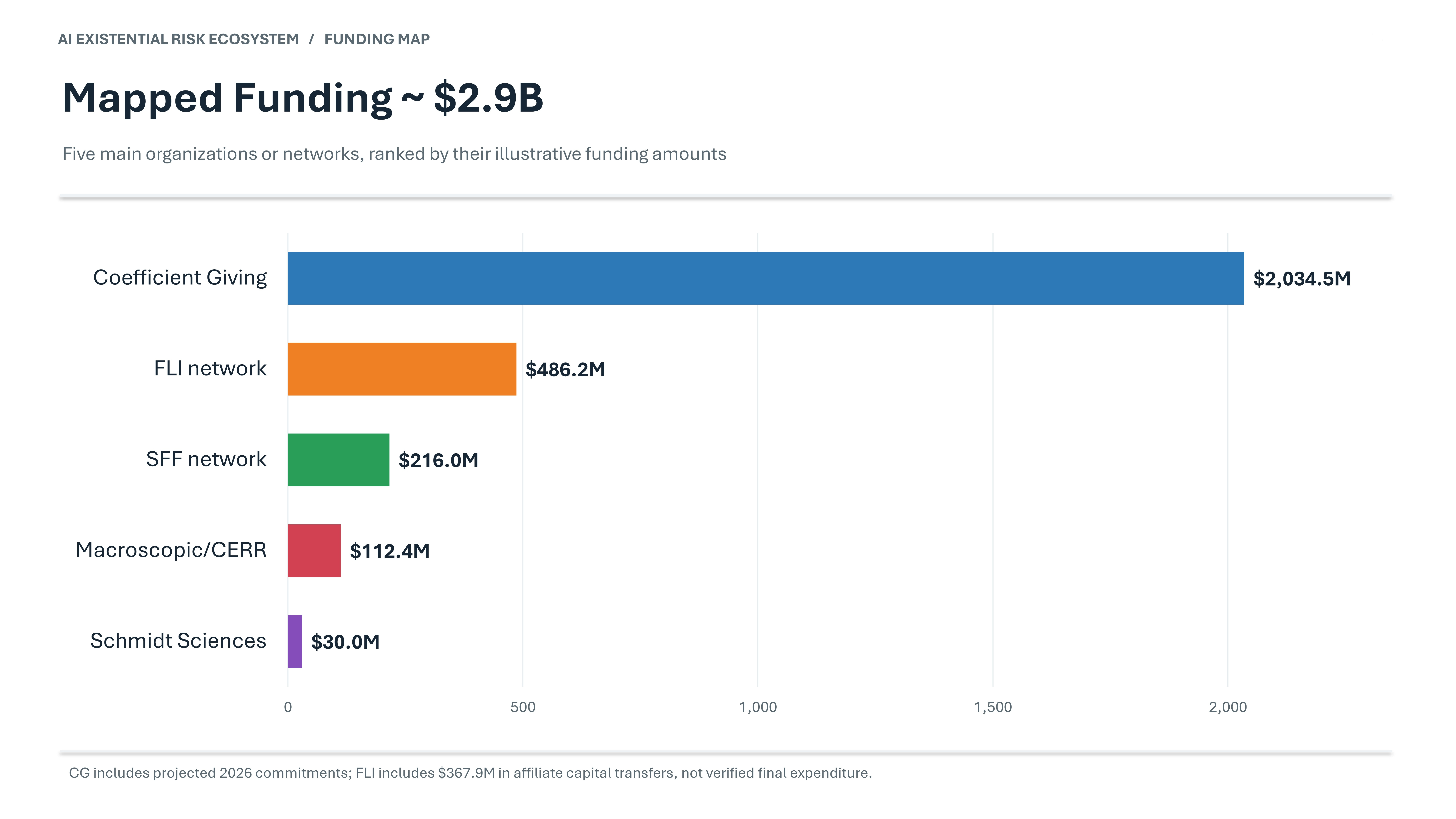
Coefficient Giving (former Open Philanthropy) (~$2.034 billion)[2]
Historical and projected AI-related funding through 2026, covering technical AI safety, governance, and field building.
FLI – Future of Life Institute’s network (~$486.2 million)[3]
Historical FLI US expenditures and major endowment transfers to affiliated organizations, including FLI Europe, Lightcone Foundation, and Future of Life Foundation. The transfers represent capital redistribution, not proof that the money was subsequently spent. The figure includes both historical expenditure and affiliate capitalization to present FLI’s network size.
Survival and Flourishing Fund ($216 million)[4]
Cumulative philanthropic gifts and grants organized by SFF through 2026. It is not exclusively Jaan Tallinn’s money; the multiple donors include Dustin Moskovitz.
Macroscopic (former CERR) (~$112.4 million)[5]
Estimated historical AI-safety funding and projected 2026 commitments.
Schmidt Sciences ($30 million)[6]
Funding for technical AI-safety research, combining its 2025 AI Safety Science program with estimated 2026 grantmaking.
Excluded Funding
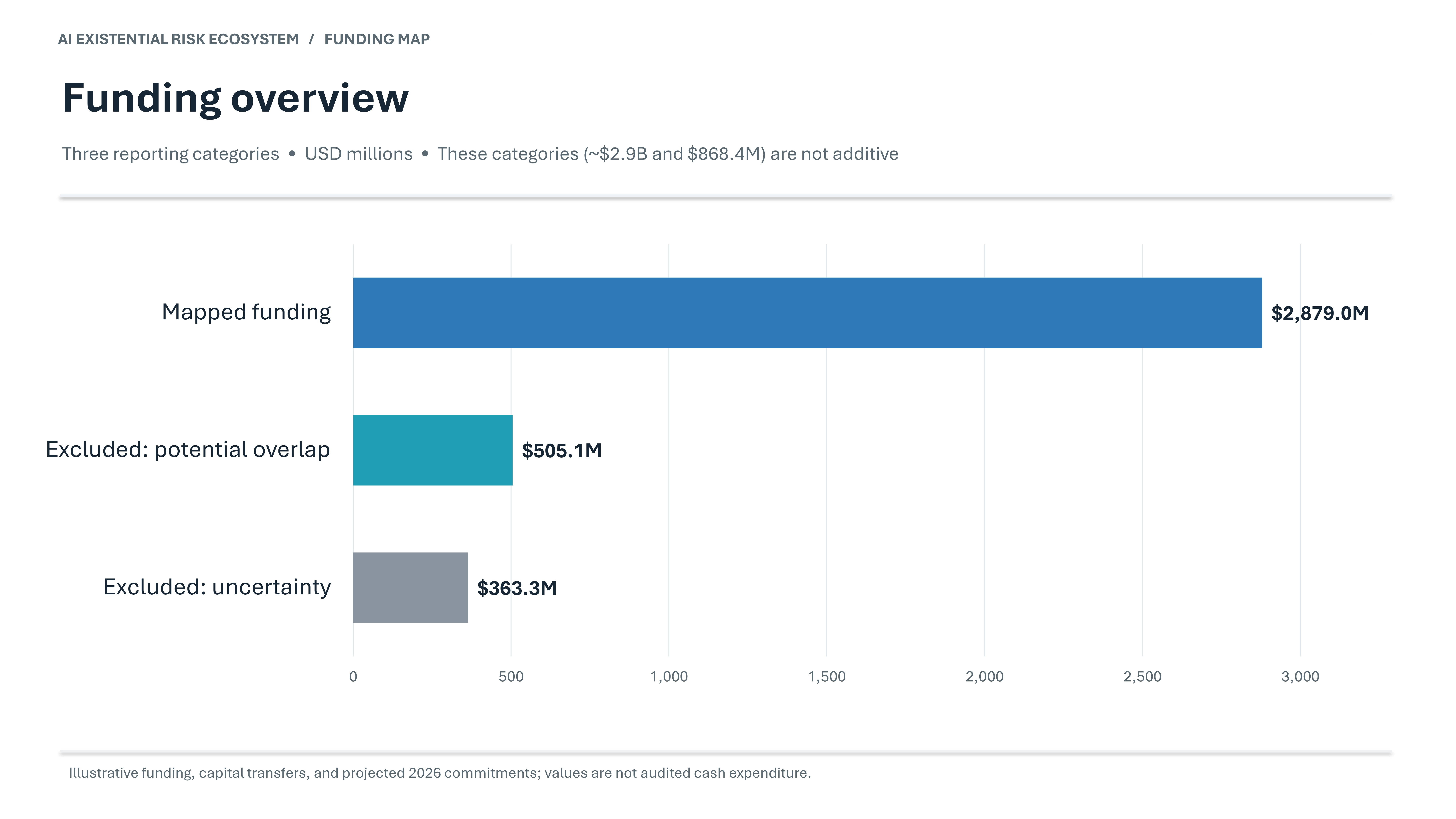
2. Funding Intermediaries and Distribution Networks (Excluded Due to Potential Overlap)
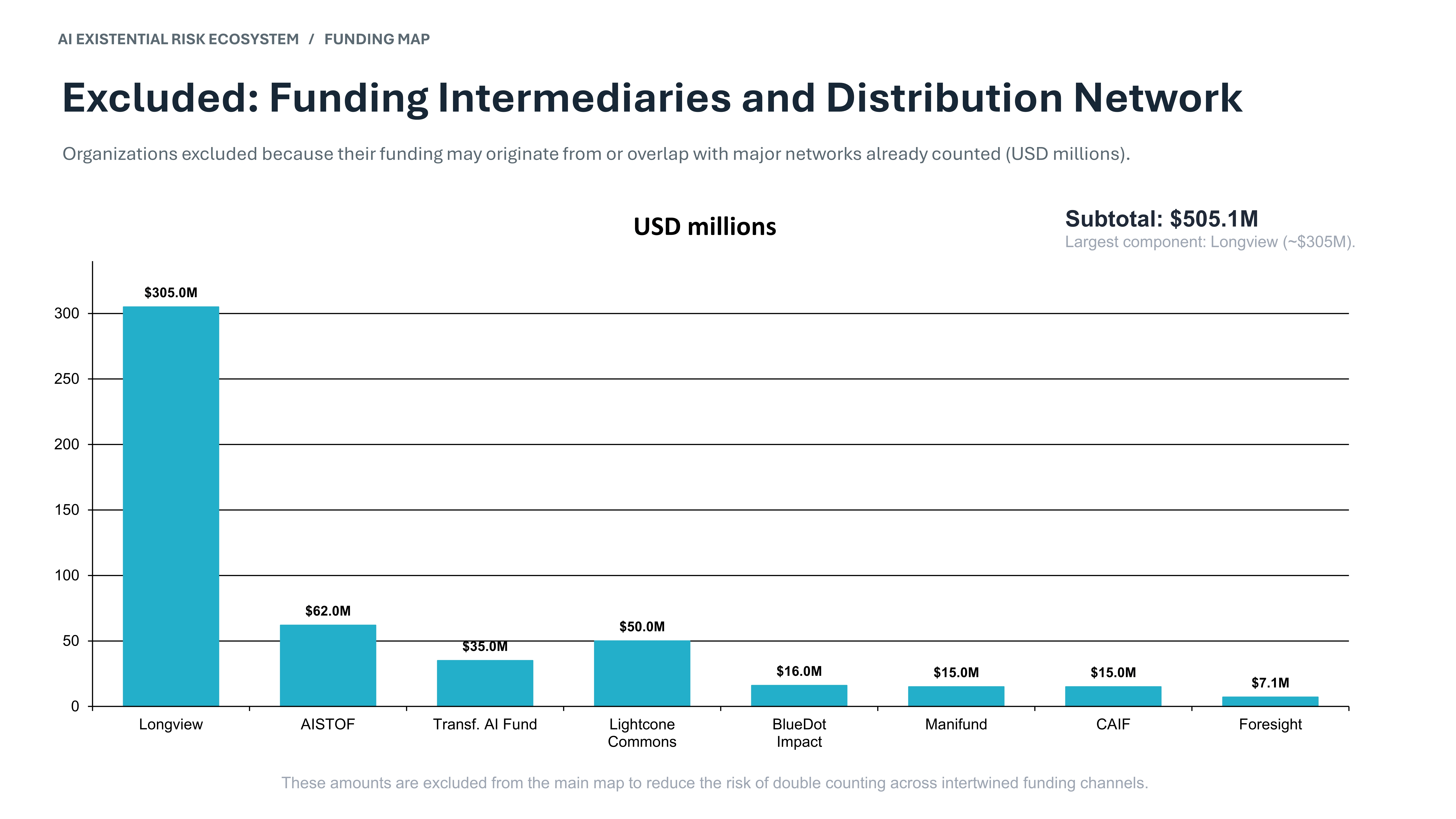
These organizations distribute, organize, or receive funding that may originate from Coefficient Giving, FLI, SFF, or other sources already represented in the pie.
Longview Philanthropy (~$305 million)[7]
Estimated historical and projected funding through 2026. Longview primarily advises donors and directs grantmaking, some of which may already be represented elsewhere in the funding map.
AISTOF – AI Safety Tactical Opportunities Fund (~$62 million)[8]
Estimated historical and projected grantmaking through 2026. Original donors are not fully disclosed, and some grants are distributed through Manifund.
Transformative AI Fund (former LTFF) (~$35 million)[9]
Historical grantmaking associated with the Long-Term Future Fund and its successor, the Transformative AI Fund. Funding may overlap with contributions from Tallinn/SFF and other philanthropic sources.
Lightcone Commons (~$50 million)[10]
Approximately $50 million in anticipated first-round grant recommendations in 2026, supported by several major AI-safety donors. This represents prospective grantmaking, not completed expenditure.
BlueDot Impact (~$16 million)[11]
Illustrative estimate combining historical funding activity and projected 2026 grantmaking. BlueDot receives substantial support from Coefficient Giving, creating potential overlap.
Estimated 2025–2026 grantmaking facilitated through Manifund, including funding from outside donors and other funds already represented in the ecosystem.
CAIF – Cooperative AI Foundation ($15 million)[13]
Founding philanthropic commitment from CERR/Macroscopic, already represented in Macroscopic’s funding activity.
Foresight Institute (~$7.1 million)[14]
Historical grants and 2026 commitments supporting AI safety and related scientific research. Some funding originated from FLI and SFF, creating potential overlap.
A donation intermediary without a separately established AI x-risk funding total. Its contributions may already be attributed to the original donors or recipient organizations.
-Subtotal: Approximately $505.1 million in gross funding activity excluded because of actual or potential overlaps.
3. Excluded because the funding amount, purpose, or timing remains uncertain
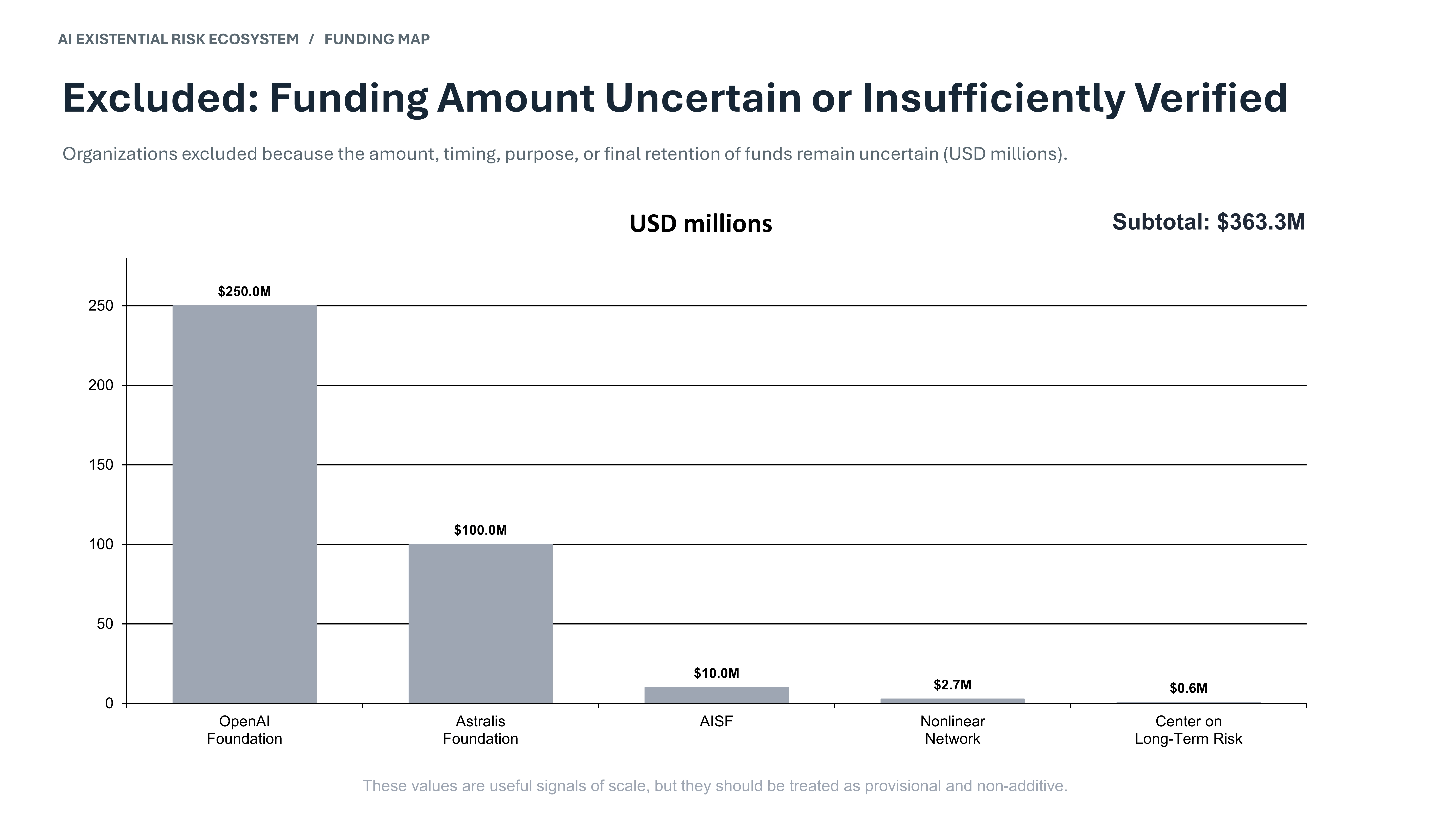
OpenAI Foundation (~$250 million estimated)[16]
Projected 2026 AI-resilience funding covering biosecurity, cybersecurity, model safety, and other societal risks. The full grant breakdown has not been published, and the estimate is broader than existential AI risk.
Astralis Foundation (~$100 million projected for 2026)[17]
Estimated funding mobilized and targeted for 2026. Most donors remain undisclosed, and potential overlaps with GTR Foundation, Macroscopic, and other funders have not been resolved.
AISF – AI Safety Fund (Frontier Model Forum) (~$10 million)[18]
Initial funding commitments from frontier AI companies and philanthropic partners. Donor contributions may overlap with other organizations in the funding map.
Nonlinear Network (~$2.7 million)[19]
Funding reportedly coordinated through Nonlinear Network grant rounds, with limited visibility into original donors and possible overlaps.
Center on Long-Term Risk (~$628,000)[20]
Reported fundraising from a 2023 campaign. The portion attributable specifically to AI existential risk and the extent of potential donor overlap remain uncertain.
Other incompletely quantified funds[21]
Paradigm 3, AIAF – AI Alignment Foundation, SHfHS – Saving Humanity from Homo Sapiens, Meta Charity Funders, Ergo Impact, and The Navigation Fund.
These funds are excluded because their original funding sources or relevant cumulative grantmaking totals cannot be reliably established.
-Subtotal: Approximately $363.3 million in additional estimated or insufficiently reconciled funding activity, excluding funds without usable totals.
4. Other funding deliberately kept outside the pie
Jan Beckers / GTR Foundation and Ocean Investment (€50 million)[22]
A separately announced multiyear commitment to AI-safety grants and impact investments, intended for deployment over three to seven years. Thus, it is not assumed to be fully spent by the beginning of 2027 and is also excluded because the division between philanthropic and commercial funding remains unclear.
Corporate support for AI-policy advocacy and separately reported personal political contributions by Anthropic employees. These activities are outside the philanthropic funding total shown in the pie chart.
FTX Future Fund (~$32 million)[24]
An estimated $32 million in AI-safety grants announced in 2022, before FTX’s collapse in November. Some grants were never disbursed, while others were subsequently returned or settled through bankruptcy proceedings. The total ultimately retained by recipients remains unknown.
Grantmaking.AI / Anton Makiievskyi (~$1 million)[25]
A separately identifiable donor-funded grant program focused specifically on reducing AI existential risk. Potentially additive, but excluded pending confirmation of actual disbursements.
Schmidt AI2050 ($125 million five-year commitment)[26]
A broader research initiative supporting AI’s long-term societal benefits, rather than an exclusively existential-risk program. Kept separate from Schmidt Sciences’ AI-safety funding.
Venture-capital investments[27]
Excluded because commercial investments in AI startups are not equivalent to philanthropic AI existential-risk funding.
5. Bottom line:
~$2.9 billion: Illustrative gross funding total represented in the pie, assuming the included 2026 projections are fulfilled. This includes historical funding, grants, capital transfers, and projected 2026 commitments.[28]
~$870 million: Additional reported, estimated, or projected funding activity excluded because of potential overlaps, undisclosed donor sources, incomplete verification, or uncertain timing. These amounts cannot simply be added to the $2.9 billion.[29]
€50 million: Jan Beckers’ separately announced commitment to AI-safety grants and impact investments over three to seven years, excluded because its timing, financial structure, and possible overlaps remain unresolved.[30]
Final Remark
This is a work-in-progress. I will continue updating these figures as new grants, disclosures, and corrections emerge.
For years, this newsletter has investigated the rise of AI doomerism, tracing its origin to the overlapping movements of rationality and effective altruism, and examining its quasi-theological, secular-apocalyptic worldview.
The reporting has challenged the doomers’ misleading narratives, falsehoods, and false balance, as well as the arguments presented in their “doom bible,” which left many reviewers unconvinced.
At the heart of this ideology are weak foundations: speculative, anthropomorphic, and unsubstantiated scenarios that neglect socio-technical realities. Yet, these narratives have received enormous media attention, particularly in Western countries.
Revealing the scale and interconnectedness of this financial network helps explain how AI-doomer ideas gained visibility and influence.
Appendix: Methodology and Sources
This investigation draws on publicly available financial records, grant databases, nonprofit tax filings, organizational disclosures, and funding announcements. The primary sources include Manifund’s Trace database, Coefficient Giving’s grants database, IRS Form 990 filings accessed through ProPublica, the Future of Life Institute’s financial disclosures, the Survival and Flourishing Fund’s grant records, and Manifund’s AI Safety Funder Bulletin.
Additional figures were cross-checked against organizations’ annual reports and grant announcements. Where possible, individual grants were examined to reconstruct historical totals, identify original funders, and distinguish direct funding from money distributed through intermediaries.
The analysis combines historical grants, organizational expenditures, capital transfers, and projected 2026 commitments, with these distinctions explicitly noted.
The resulting funding map is an illustrative reconstruction of the ecosystem’s financial scale, not an audited accounting of money actually spent or funding exclusively dedicated to AI existential risk.
To reduce double-counting, the main calculation excluded potentially overlapping funding and amounts lacking sufficient verification, and reported them separately.
Endnotes
[1] Total: $2,034,467,156 + $486,154,354 + $216,000,000 + $112,400,000 + $30,000,000 = $2,879,021,510 ($2.879 billion), rounded to $2.9 billion.
[2] The Trace grant database‘s calculation, as captured on October 13, 2026: $968,825,582 in grants classified under four principal AI-safety categories through 2025, plus $65,641,574 in additional general AI-safety grants and estimates. Historical subtotal: $1,034,467,156. Adding $1 billion in anticipated 2026 commitments brings the total to approximately $2.034 billion. Coefficient Giving announced in September 2026 that it expected to commit over $1 billion during 2026. The 2026 component represents anticipated commitments, not verified expenditure.
[3] The calculation includes $118,244,608 in historical FLI US expenditures (2014–2025), excluding the specified 2022 affiliate transfers, plus $367,909,746 in endowment transfers: $180,297,079 to FLI Europe, $162,587,667 to Lightcone Foundation, and $25,025,000 to Future of Life Foundation. Total: $486,154,354 (rounded to $486.2 million). The affiliated entities have overlapping leadership, including Max Tegmark and Jaan Tallinn. The total combines expenditures and affiliate capitalization, without counting those transfers twice. It does not establish how much of the transferred capital was subsequently spent by the recipients.
The importance of #Shibagate: Vitalik Buterin’s 2021 Shiba Inu donation to the Future of Life Institute created another nine-figure pool of AI existential risk funding. I’m responsible for exposing this donation and how, weeks after FTX’s collapse, FLI moved its hundreds of millions to three affiliated entities.
[4] SFF’s official cumulative funding summary reports approximately $216 million organized between 2019 and 2026. Its published annual figures are $2M (2019), $5M (2020), $20M (2021), $16M (2022), $33M (2023), $41M (2024), $35M (2025), and $64M (2026), totaling $216M. This represents funding organized, including grant recommendations, rather than audited cash disbursements exclusively for AI existential risk.
[5] Includes approximately $42.4 million in historical AI-safety funding (2019–2025), plus a projected $70 million in 2026. The latter assumes that AI safety accounts for 70% of Macroscopic’s announced budget of up to $100 million in 2026. Sources: Macroscopic and Manifund’s AI Safety Funder Bulletin. The historical figures include estimated allocations and multiyear commitments, while the 2026 figure is a projection, not verified expenditure.
[6] $10 million for AI-safety research in 2025, as reported by Schmidt Sciences, plus $20 million in estimated 2026 funding from Manifund’s October 15 Funder Bulletin. The 2026 estimate is based on Schmidt Sciences’ research-funding programs and requests for proposals (RFPs), rather than a confirmed total of 2026 awards.
[7] Manifund’s Trace database reports approximately $303.5 million categorized as AI safety and $945,000 as technical AI-safety research, totaling approximately $304.4 million (rounded to ~$305M). These are database estimates, with limited grant-level disclosure. Manifund’s Funder Bulletin also notes Longview’s reported $75M+ in funds directed in 2025 and an earlier $200M target for 2026, since removed from hiring materials. Longview-advised funding may originate from donors already counted elsewhere.
[8] Estimated $22 million in historical grantmaking (2023–2025) plus $40 million projected for 2026. The historical component can be reconstructed from Manifund Trace, which estimates $47M in lifetime giving, including approximately $25M attributed to 2026 ($47M − $25M = $22M). The higher $40M projection for 2026 comes from Manifund’s Funder Bulletin. AISTOF’s own Manifund account reports more than $30M raised, but covers only one grantmaking channel. Much of the Trace estimate is not supported by itemized grants. The $62M is therefore a combined estimate, not a verified disbursement total.
[9] The former Long-Term Future Fund reported just under $35 million in cumulative grants since 2017, across more than 820 grants, before its August 2026 closure and transition to the Transformative AI Fund. Manifund’s October 15 bulletin reconciles that figure with the EA Funds grant records. Public itemized grant records are incomplete, and the historical LTFF figure should not be treated as a separately verified lifetime total for its successor.
[10] The approximately $50M estimate comes from Nathan Young’s October 12, 2026 update, documented in Manifund’s Funder Bulletin. The original first-round estimate was $15M–$25M. Lightcone Commons lists prospective funding from Jaan Tallinn, Dustin Moskovitz, LTFF, anonymous donors, and others. As of October 15, first-round recommendations had not been published. Funds are expected to be distributed by participating donors, rather than necessarily held by Lightcone Commons; potential overlaps remain.
[11] Illustrative estimate: approximately $6.43 million in historical funding received during 2022–2024 ($2,009,000 in 2022, $1,931,254 in 2023, and $2,491,811 in 2024), plus approximately $9.9 million in projected 2026 grantmaking, totaling ~$16.33 million (rounded to ~$16M). Sources: Manifund’s Trace database and AI Safety Funder Bulletin. The latter has since revised its 2026 projection to $10.1 million. Most of BlueDot’s historical funding originated from Coefficient Giving, creating substantial overlap with the main funding map.
[12] Approximately $6 million in AI-safety-related grantmaking in 2025, plus an estimated $8.8 million projected for 2026, totaling ~$14.8 million (rounded to ~$15M), based on Manifund’s AI Safety Funder Bulletin (October 15, 2026). Earlier grantmaking (2023–2024) is excluded because a reliable AI-risk-specific subtotal has not been established, while the platform’s all-time figures include funding for other causes. The 2026 figure is a projection rather than verified expenditure. Manifund facilitates grants from outside donors and funds, including AISTOF, creating potential overlaps with funding already counted elsewhere.
[13] The Cooperative AI Foundation confirms its founding $15 million philanthropic commitment from Macroscopic Ventures, formerly the Center on Emerging Risk Research (CERR), announced in 2021. The figure represents an initial commitment rather than verified cumulative expenditure. It is excluded to avoid counting the same underlying funding twice.
[14] Foresight Institute’s 2026 impact report records $5,891,163 in grants during 2023–2025 and $1,206,988 committed during 2026. Combined: $7,098,151, or approximately $7.1 million. The total spans research fields beyond existential AI risk, and includes 2026 commitments rather than only completed payments. Some original funding sources may already be included elsewhere.
[15] Giving What We Can facilitates donations to external charities and funds. Because an independently sourced AI existential-risk subtotal has not been established, no separate amount is included. Counting donations routed through GWWC in addition to their recipient organizations could inflate the aggregate.
[16] The $250M figure is a 2026 projection from Manifund’s AI Safety Funder Bulletin, not an officially confirmed OpenAI Foundation grant total. The Foundation’s June 2026 announcement described its AI-resilience program, while Manifund reports more than $130M in grants being finalized. A $17.2M award to SecureBio was separately reported by the recipient. The remaining allocation, grant recipients, and amount specifically devoted to existential risk have not been independently reconciled.
[17] According to Manifund’s October 15 Funder Bulletin, an August 2026 Astralis job posting stated that the foundation had mobilized more than $60M in 2026 and aimed to reach approximately $100M by year-end. Its official website does not publish a comparable cumulative financial total. The estimate reflects fundraising or funding mobilization, not necessarily completed grant payments. Astralis also jointly announced an approximately $10M AI-governance initiative with Macroscopic, which may overlap with amounts recorded elsewhere.
[18] The Frontier Model Forum confirms an initial funding commitment exceeding $10 million, announced in October 2023. Contributors included Anthropic, Google, Microsoft, OpenAI, the Patrick J. McGovern Foundation, the Packard Foundation, Schmidt-related philanthropy, and Jaan Tallinn. The figure represents initial commitments rather than a reconciled total of grants disbursed. Some original contributors appear elsewhere in this funding map.
[19] A grantmaking.ai organization profile reports approximately $1.5M distributed in the first round and $1.2M in the second, totaling ~$2.7M. Nonlinear’s original description of the network explains its role connecting applicants with multiple independent funders. A complete primary grant ledger has not been identified, and grants coordinated by Nonlinear should not automatically be treated as funding originating from Nonlinear itself.
[20] The Center on Long-Term Risk’s 2023 fundraising page reports $628,038 raised toward a $770,000 goal. This is a campaign-specific fundraising amount, not the organization’s lifetime income or total AI x-risk expenditure. Some contributors are anonymous, and the fund’s activities extend beyond a narrowly defined AI existential-risk category.
[21] These organizations and funds are identifiable, but a consistent, independently verifiable AI x-risk funding total cannot currently be reconstructed for each. Public information does not always distinguish original donations, grants administered for others, commitments, and completed disbursements. No numerical estimate from these funds is included in the excluded-funding subtotal.
[22] The GTR Foundation’s September 2026 announcement confirms Jan Beckers’ €50M commitment over three to seven years. The initiative includes philanthropic grants through the GTR AI Safety Fund and impact investments through Ocean Investment. No verified annual disbursement schedule or division between grants and investments has been published. Potential overlaps with Astralis and other recipients remain unresolved.
[23] $40M in corporate contributions to Public First Action in 2026, confirmed by Anthropic, plus approximately $5.18M in individual contributions by Anthropic employees to AI-related political organizations and campaigns, according to the Transformer political-donations tracker. Combined: ~$45.18M, rounded to $45.2M. Employee contributions are personal, not corporate donations. Anthropic states that its corporate support was restricted to public education and policy advocacy and could not be used to influence candidate elections.
Note: Anthropic’s anticipated IPO could create tens of billions of dollars in new philanthropic wealth, potentially channeling even more money into causes such as AI existential risk. If those expectations materialize, the network established during the first AI-safety funding boom could soon command unprecedented financial resources.
[24] The ~$32M estimate comes from the 2023 analysis An Overview of the AI Safety Funding Situation, which reconstructed AI-safety grants from February through August 2022 using FTX Future Fund grant announcements. Following FTX’s November 2022 bankruptcy, grant disbursement, repayment, and settlement outcomes varied by recipient.
[25] The Grantmaking.AI launch-round FAQ identifies a $1M funding commitment from Anton Makiievskyi for projects explicitly targeting AI existential risk. The program covers technical safety, governance, field-building, and evaluations. The figure represents committed funding for the launch round, not an independently confirmed $1M in completed grant payments.
[26] The Schmidt Futures April 2022 fact sheet (p. 44) announces Eric and Wendy Schmidt’s $125M commitment over five years to AI2050. Funding supports researchers addressing opportunities and challenges related to AI’s societal benefits. The amount represents a multiyear program commitment, not verified AI existential-risk spending, and should not be conflated with Schmidt Sciences’ separate AI-safety program.
[27] The map excludes equity investments, convertible instruments, and other commercial financing. Such funding may support AI-safety-oriented companies, but it creates an investment asset and potential financial return, unlike a charitable grant. No venture-capital amount is included in the headline totals.
[28] Calculation, in USD millions: Coefficient Giving ($2,034M) + FLI network ($486.2M) + SFF ($216M) + Macroscopic ($112.4M) + Schmidt Sciences ($30M) = $2,879M, or approximately $2.9 billion. This is a sum of different funding measures, not audited expenditure. Each component is explained in footnotes 2-6.
[29] Calculation, in USD millions:
Potential overlaps: Longview (305) + AISTOF (62) + Transformative AI Fund (35) + Lightcone Commons (50) + BlueDot (16) + Manifund (15) + CAIF (15) + Foresight (7.1) = $505.1M.
Uncertain funding: OpenAI Foundation (250) + Astralis (100) + Frontier Model Forum AISF (10, used as the minimum reported amount) + Nonlinear (2.7) + Center on Long-Term Risk (0.628) = approximately $363.3M.
Combined: approximately $868.4M, rounded to $870M.
These are gross estimates with possible overlaps within and between categories.
[30] See the GTR Foundation’s September 2026 announcement. The €50M has not been converted into U.S. dollars or added to either headline subtotal.